

Innovations in Industrial Lasers – Lighting the Path to Precision Manufacturing

Laser technology has become an inseparable part of modern manufacturing. From cutting and welding to marking, drilling, cladding, and additive manufacturing, lasers have revolutionized industrial processes with their precision, speed, and flexibility. In recent years, rapid innovation has further transformed industrial lasers—driven by advances in beam control, power scaling, fiber technology, and digital integration. The result is a new era of intelligent, energy-efficient, and highly adaptable laser systems redefining the contours of precision manufacturing.
Evolution of Industrial Laser Technology
Industrial lasers have come a long way since their introduction in the 1960s. Initially dominated by CO₂ and Nd:YAG lasers, the field has gradually evolved with the emergence of diode and fiber lasers. Each generation brought improvements in efficiency, reliability, and beam quality.
The shift from gas-based to solid-state and fiber-based systems marked a key inflection point, allowing compact, maintenance-free, and high-power solutions suited to harsh industrial environments.
Today’s lasers are more than just sources of light—they are digitally networked systems equipped with sensors, intelligent control units, and adaptive optics. With these innovations, lasers now enable micrometer-level precision and repeatability in mass production environments—something unimaginable a few decades ago.
Fiber Lasers – The Benchmark for Modern Industry
The fiber laser stands as one of the most significant innovations in industrial laser technology. Its architecture—where the active gain medium is integrated into a flexible optical fiber—offers outstanding beam quality, low maintenance, and long operational life. Unlike gas or crystal lasers, fiber lasers eliminate alignment issues and allow efficient cooling through their large surface area-to-volume ratio.
High-power fiber lasers (ranging from a few hundred watts to tens of kilowatts) are now widely used in automotive, aerospace, shipbuilding, and construction equipment manufacturing. They excel in cutting thick metals, performing deep-penetration welding, and even surface hardening.
The scalability of fiber lasers, combined with their high wall-plug efficiency (up to 50%), has made them the industry’s go-to choice for cost-effective, high-performance applications.
Recent developments in multi-mode fiber designs, beam combining, and pulse shaping have further extended their capabilities. Manufacturers can now switch between continuous-wave and pulsed operation, or dynamically adjust beam parameters to suit materials and tasks—ushering in new levels of versatility.
Ultrashort Pulse Lasers – Precision Without Heat
While high-power lasers dominate heavy industrial applications, the demand for ultra-precise, minimal-heat processes in electronics, medical device manufacturing, and micro-machining has led to the rise of ultrashort pulse (USP) lasers. These include picosecond and femtosecond lasers that emit pulses so brief that material removal occurs before heat can spread to the surrounding area—a process known as “cold ablation.”
This innovation enables burr-free edges, micro-hole drilling, and precise patterning on metals, ceramics, and polymers alike. In semiconductor manufacturing, for instance, femtosecond lasers are used to create fine circuit paths on delicate substrates without causing thermal distortion. The technology is equally valuable in medical stent fabrication, smartphone display cutting, and solar cell texturing.
Continuous improvements in pulse repetition rates and average power output have made USP lasers more productive, while their costs are steadily decreasing due to better pump diodes and compact architectures. These systems represent the pinnacle of non-thermal precision processing.
Laser Additive Manufacturing – Building the Future Layer by Layer
Another area transformed by laser innovation is additive manufacturing (AM), commonly known as 3D printing. Laser-based powder bed fusion (LPBF) and directed energy deposition (DED) techniques use focused laser beams to melt and fuse metallic powders or wires into complex, high-strength components layer by layer.
This has opened up new design possibilities for aerospace, medical implants, and tooling industries, where lightweight, custom, or topology-optimized parts are in demand. High-power lasers with precisely controlled beam profiles ensure consistent layer formation and surface finish, reducing post-processing needs.
Recent breakthroughs in multi-laser systems, where several beams work simultaneously, have significantly improved production speed. Additionally, the integration of real-time process monitoring and closed-loop control ensures better quality assurance and repeatability—key to scaling AM for industrial production.
Smart and Connected Lasers – Integration with Industry 4.0
In keeping with the Industry 4.0 philosophy, modern laser systems are no longer isolated units but integral parts of smart factories. They feature embedded sensors, IoT connectivity, and AI-driven control systems that enable predictive maintenance and adaptive operation.
For instance, by monitoring back-reflected light, temperature, or vibration, the laser system can detect deviations and self-adjust its parameters in real time to maintain consistent results. This self-optimization not only enhances quality but also extends equipment life and minimizes downtime.
Digital twins—virtual replicas of laser systems—are being employed to simulate performance, predict wear, and plan maintenance. Furthermore, machine learning algorithms analyze massive datasets from laser operations to refine cutting or welding recipes automatically. This intelligence transforms lasers from mere tools into active participants in the production ecosystem.
Green Lasers and Wavelength Innovation
Another frontier in laser development involves exploring new wavelengths beyond the traditional infrared domain. Green (532 nm) and ultraviolet (355 nm) lasers, for example, offer superior absorption in materials like copper, gold, and plastics—making them ideal for battery and electronics applications.
Green lasers, particularly, have proven invaluable in e-mobility manufacturing, where joining thin copper foils or welding battery tabs requires precise control without spatter or reflection losses. Shorter wavelengths also enable finer focus spots, yielding higher precision in micromachining and engraving applications.
Ongoing R&D in blue and mid-infrared lasers continues to expand material compatibility and process efficiency. These wavelength innovations will play a vital role in next-generation industries such as EVs, renewable energy, and microelectronics.
 Laser Cladding and Surface Engineering
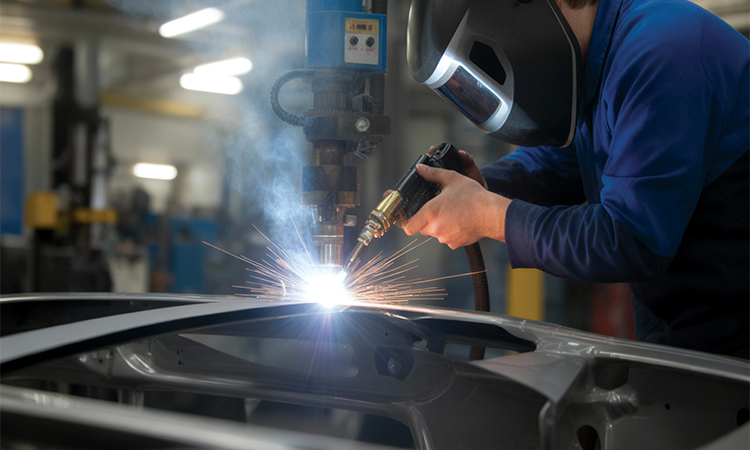
Industrial lasers are not limited to cutting or joining—they also excel in surface modification and repair applications. Laser cladding uses a focused beam to deposit material onto a substrate, improving wear resistance or corrosion protection. The process allows localized coating of high-value components like turbine blades, shafts, and dies, extending their service life with minimal distortion.
Advances in beam shaping and powder delivery have made laser cladding faster, cleaner, and more uniform. Hybrid systems now combine laser cladding with milling or grinding heads, enabling one-step refurbishment or surface engineering of critical parts. Such innovations help industries minimize waste and embrace sustainable manufacturing practices.
Compact, Energy-Efficient, and User-Friendly Systems
The drive for compactness, efficiency, and simplicity is evident in recent laser system designs. Modular platforms, all-in-one fiber sources, and integrated cooling systems have made lasers more accessible to small and medium enterprises. Energy consumption per watt of output continues to decline, while automated alignment and plug-and-play controls have reduced the skill barrier for operators.
Portable laser cleaners, handheld welders, and marking units are now finding favor in workshops and maintenance operations, bringing the advantages of laser precision to field applications. These innovations are democratizing laser technology, expanding its reach beyond large-scale industries.
Sustainability Through Laser Technology
Sustainability is another driving force behind innovation. Lasers inherently promote resource efficiency—producing less waste, reducing material consumption, and minimizing rework. Energy-efficient fiber lasers, dry laser cleaning (which eliminates chemical solvents), and recyclable laser additive processes all contribute to greener manufacturing.
Moreover, as industries transition to electric mobility and renewable energy systems, lasers play a pivotal role in the production of batteries, solar panels, and hydrogen fuel cells—technologies at the heart of the green economy.
The Road Ahead
The pace of innovation in industrial laser technology shows no sign of slowing. Future developments are expected to center around AI-integrated beam control, multi-wavelength hybrid systems, quantum cascade lasers, and high-speed parallel processing. As these advances mature, lasers will become even more versatile, intelligent, and sustainable.
In essence, industrial lasers are no longer just light sources—they are precision instruments at the intersection of optics, electronics, and digital intelligence. Their evolution is lighting the way toward smarter, cleaner, and more efficient manufacturing—heralding a bright future for industry worldwide.
Would you like me to include a highlight box summarizing the key innovations (e.g., fiber lasers, ultrashort pulse lasers, green lasers, laser AM, etc.) for layout use in the magazine?